Home / How Shilang (Pangasius) Cage Farming Works
How Shilang (Pangasius) Cage Farming Works
From an empty stretch of reservoir to a harvest net: the steps behind cage-farmed Shilang (pangasius).
What cage farming means
Shilang is the local name for pangasius, a hardy freshwater fish that suits farming. In cage farming the fish live inside net enclosures that float in a larger body of water, such as a reservoir or lake. The water flows through the net, but the fish stay in one place where they can be fed, watched and harvested.
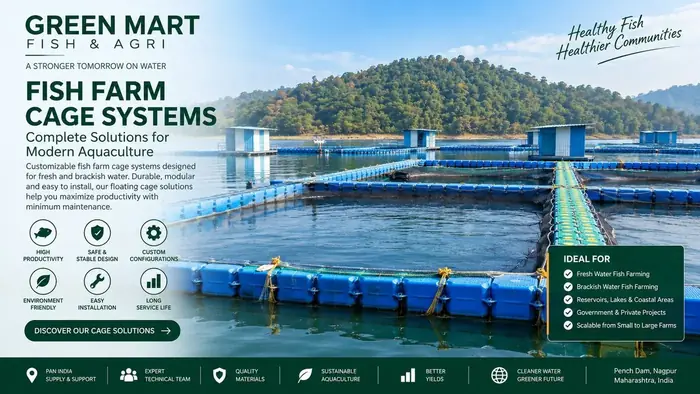
At Green Mart we raise pangasius, sold as Shilang, in cages at Navegaon Reservoir, Nagpur. Our cages are circular and float on the reservoir. This page explains the general method, step by step, so buyers know what stands behind the fish they order.
Step 1: Choose the site
Everything starts with the water. A good cage site has enough depth under the cages, steady water exchange and shelter from the worst wind and waves. It also needs reliable access by boat or walkway, and permission to use the water body. A site that fails on any of these is hard to fix later, which is why site assessment comes before buying a single net.
Step 2: Build and anchor the cages
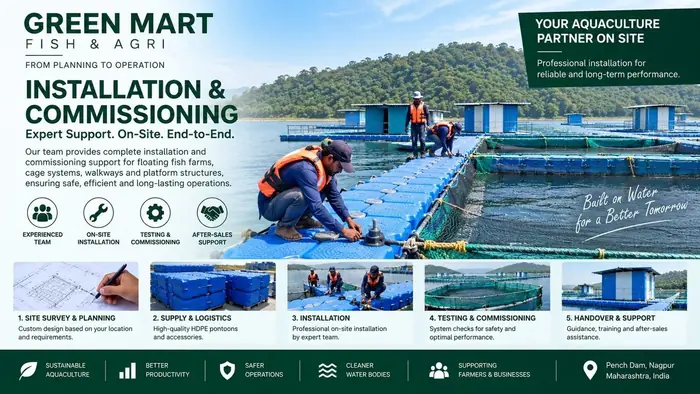
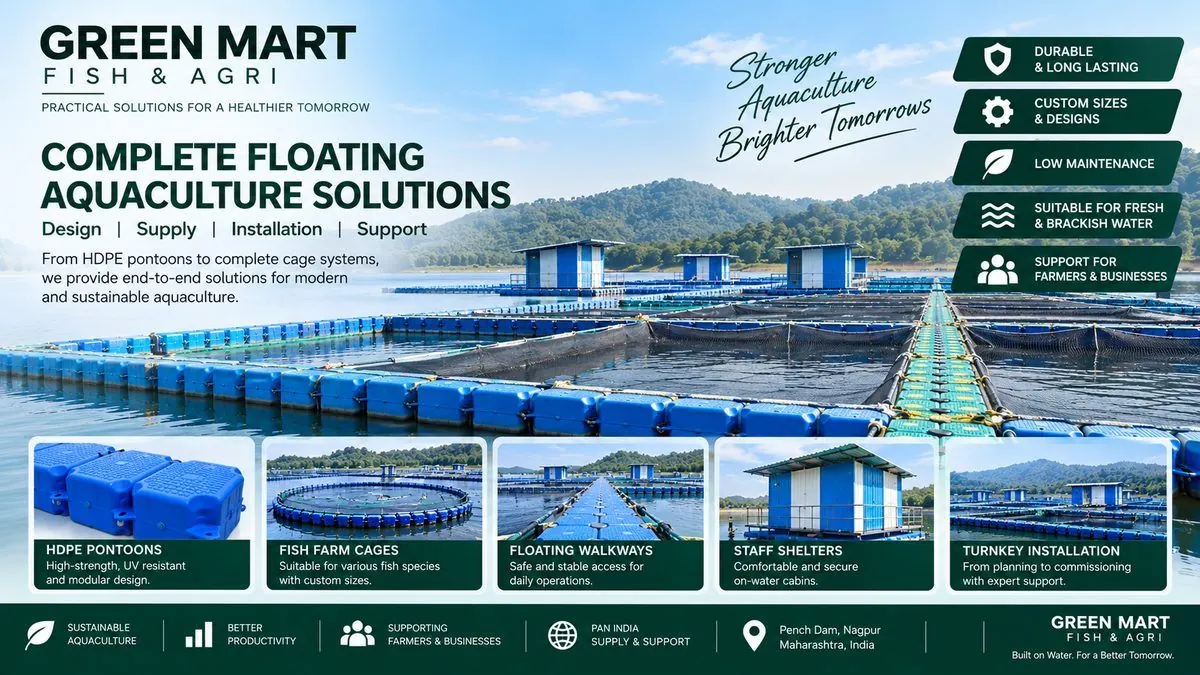
A cage has three main parts: a floating frame, a containment net hung from it, and a mooring system that holds it in place. Frames are usually built from HDPE floats, which resist sun and water. Walkways connect the cages so staff can feed and inspect them without leaving the platform. Anchoring has to allow for rising and falling water levels. Our fish farm cage systems page covers the infrastructure in more detail.
Step 3: Stock the fingerlings
Farming begins with young fish called fingerlings, which are sorted by size and checked for health before they go into the cages. Stocking too many fish in one cage strains oxygen and feed, so numbers are set by cage size and water conditions rather than by a fixed rule. Keeping fish of similar size together also helps them grow evenly.
Step 4: Feed carefully
Cage fish depend entirely on the farmer for food. They are given formulated feed in measured amounts, and the ration is adjusted by watching how eagerly the fish eat. Feed that sinks uneaten is wasted money and adds to the load on the water, so careful feeding is one of the biggest skills in the job.
Step 5: Watch the water and the fish
Daily management is mostly observation. Staff check the nets for damage, watch fish behaviour, and test the water regularly. At Green Mart, feeding and stock are written down every day for each cage, so each batch can be traced. Buyers can ask for test reports and records on WhatsApp. Heavy rain, a sudden temperature change or a drop in oxygen can all affect fish health, and early notice gives time to respond.
Step 6: Harvest and handling
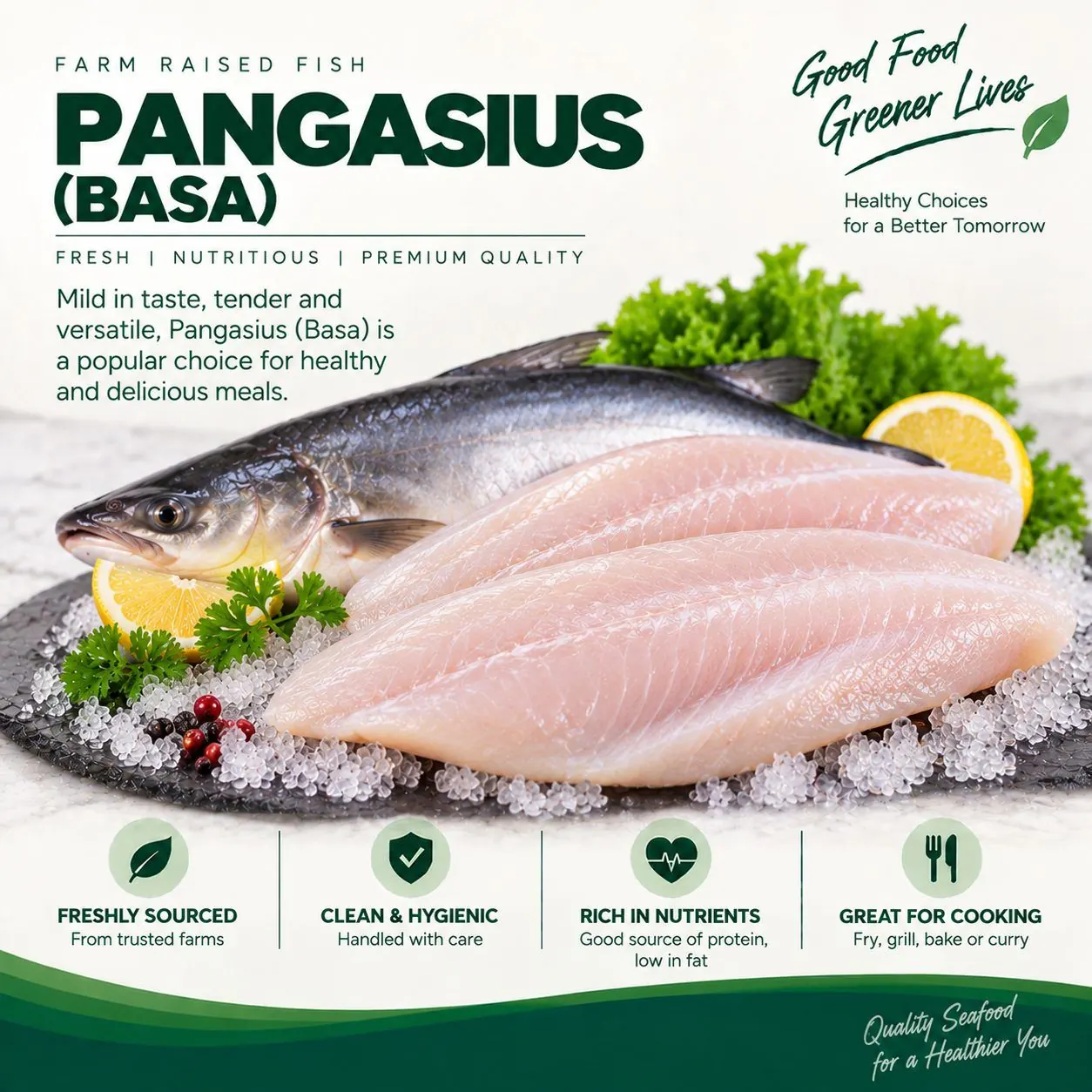
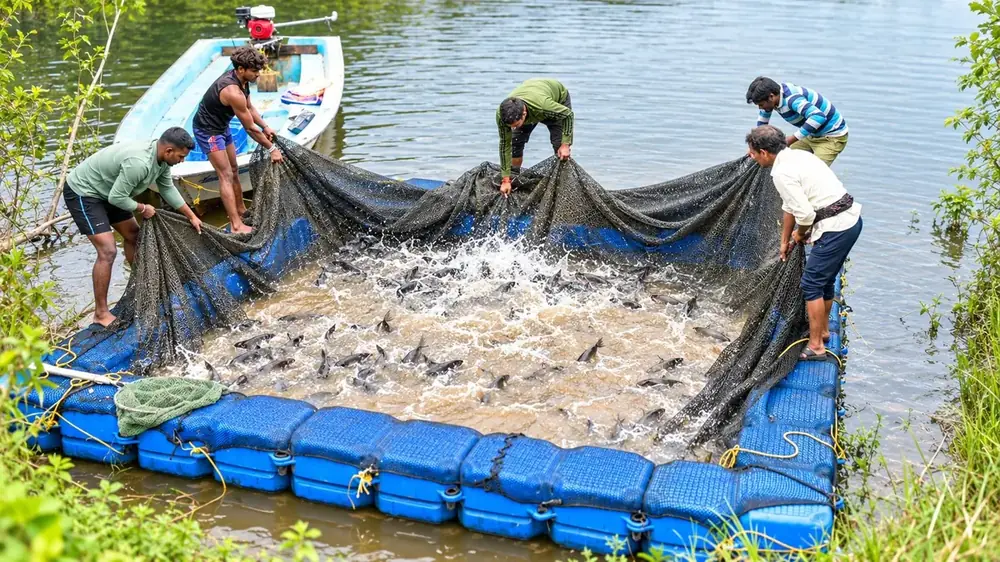
When the fish reach market size, the net is hauled in and the fish are lifted out, graded by size and iced quickly. Speed and cold are what protect freshness, because quality starts to fall as soon as the fish leave the water. Fish can then be sold whole, cleaned or cut to order. At Green Mart, Shilang is sold whole, cleaned or as a fresh fillet cut, in size grades of 800g–1kg, 1–1.2kg and 1.2kg+. You can see the formats on our Fresh Shilang (Pangasius) page.
Trade-offs worth knowing
Cage farming uses water that already exists and lets a farm grow cage by cage. But cages are exposed to weather, depend on permission to use the water body, and need daily attention. Done well, it turns a reservoir into a managed farm. Done carelessly, it can strain the water it depends on.
Common questions
What is Shilang?
Why farm Shilang (pangasius) in cages instead of ponds?
How long does Shilang (pangasius) take to reach harvest size?
What do Shilang (pangasius) eat in a cage?
Can I buy cage-farmed Shilang (pangasius) in bulk in Nagpur?
Want fresh cage-farmed Shilang?
Tell us the quantity, the cut you prefer and your location. We will confirm today's rate and delivery on WhatsApp.